DACH Founders: Why Entity Setup Breaks U.S. Market Entry
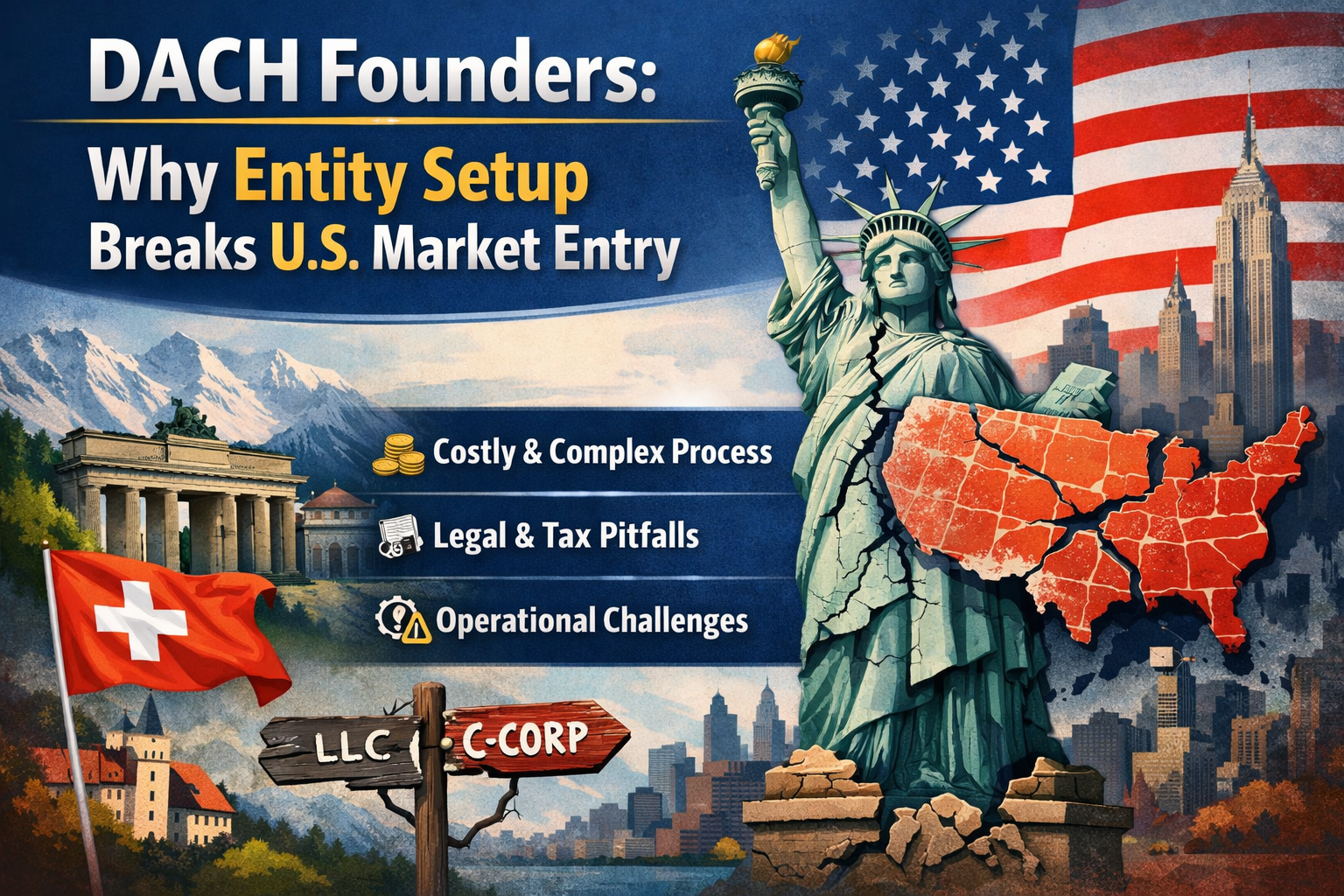
Table of Contents
- What Ecosystem Coordination Actually Means
- The Hidden Architecture Behind Entity Setup
- Why Traditional Partnerships Fail in America
- The Orchestrator Role Nobody Talks About
- Corporate Structure as Coordination Tool
- Coordination Breakdown Points
- Building Blocks for Effective Coordination
- The Investor Coordination Layer
- When Coordination Becomes Overhead
- Making It Work
Picture this: A DACH founder lands in San Francisco with a killer product, proven traction in three European markets, and $2M burning a hole in the company bank account. Six months later, they're stuck in a legal nightmare because they set up the wrong entity structure, picked the wrong state, and never considered how their corporate setup would affect everything from investor expectations to hiring VP-level talent. The product works. The market wants it. But the business architecture can't scale because nobody coordinated the foundational pieces.
This isn't about paperwork. It's about ecosystem coordination, the invisible scaffolding that determines whether your U.S. market entry thrives or collapses under its own weight.
What Ecosystem Coordination Actually Means
Most founders hear "ecosystem" and think partnerships or integrations. Wrong frame. Business ecosystems are purposeful arrangements between multiple entities that create collective value for common customers. But ecosystem coordination goes deeper than that surface definition. It's the orchestration layer that ties together your entity structure, legal framework, investor relationships, partner network, talent strategy, and market positioning into one coherent system.
Think of it like building a house. You can have the best architect, the finest materials, and skilled contractors. But if nobody coordinates the plumbing, electrical, and structural work? You get a beautiful facade with pipes that leak and lights that don't turn on.
For DACH founders navigating the U.S. market, this coordination challenge hits differently because the American business ecosystem operates on fundamentally different assumptions than European markets. The legal structures expect different investor profiles. The partnership models assume different risk tolerances. The talent ecosystem responds to different incentive structures. You're not porting your European ecosystem to America. You're building a new one from scratch, and every piece has to fit together or the whole thing falls apart.
The Hidden Architecture Behind Entity Setup
Here's what trips up smart founders: they think entity setup is a legal checkbox. File the paperwork, get the EIN, open the bank account. Done. But the orchestrator governs the diverse range of participants who contribute to the ecosystem, including control of access rights. Your entity structure is that orchestrator.
A C-Corp in Delaware isn't just a tax designation. It's a signal to the entire U.S. business ecosystem about who you are and how you operate. When a Series A investor sees "Delaware C-Corp," they know what that means: venture-scale expectations, equity compensation structures, board governance norms, exit pathways. When they see an LLC? Different conversation entirely. Different risk profile. Different cap table assumptions. Different timeline expectations.
This matters because your entity choice cascades through every other coordination decision. Want to hire a VP of Sales with equity? Better be a C-Corp with an option pool and a 409A valuation. Need to partner with enterprise customers who require vendor insurance? Your entity type affects your insurance costs and coverage options. Planning to raise from U.S. venture capital? Most funds have legal restrictions about investing in anything except C-Corps.
The mistake DACH founders make is treating this as a legal question. It's a coordination question. The entity structure determines which parts of the U.S. business ecosystem you can even access.
Why Traditional Partnerships Fail in America
European business culture builds partnerships through relationships. You meet someone at a conference, have dinner, develop trust over six months, then maybe do a pilot project. The partnership forms through repeated interactions and demonstrated reliability. American business ecosystems work backwards from that model.
U.S. partnerships start with the value proposition, then figure out the relationship. The coordination happens at the structural level before the personal level. This catches European founders off guard because it feels transactional. It is transactional. But that doesn't make it shallow. Ecosystems work best when solutions feature high levels of modularity with easily combined components and require coordination to identify and match partners.
The practical translation: when approaching a potential U.S. partner, lead with how the ecosystem coordination benefits both parties. Not "we should work together because we respect each other's companies." But "we should work together because your customer base needs our capability, our users need your infrastructure, and together we create value neither of us can deliver alone." Then define the coordination mechanisms: APIs, revenue share models, co-marketing agreements, joint sales enablement.
Here's where it gets interesting. The best U.S. ecosystem partnerships include explicit coordination rules. Who owns the customer relationship? How do support tickets get routed? What happens when a customer wants both products but negotiates on price? These coordination agreements protect both parties and prevent the ecosystem from collapsing the first time something breaks.
The Orchestrator Role Nobody Talks About
Every ecosystem needs an orchestrator. Someone has to be responsible for the structure, performance, governance, and risk management. Most DACH founders assume they're the orchestrator of their U.S. market entry ecosystem. That's often wrong.
The real orchestrator might be your lead investor who coordinates your board, introduces you to customers, and connects you with follow-on funding. Or it could be a strategic partner who brings you into their ecosystem as a participant. Or it might be your first major customer who dictates technical requirements that force you to coordinate with their vendor ecosystem. Understanding who actually orchestrates your ecosystem changes everything about how you operate.
When a DACH founder stays in Europe and tries to orchestrate a U.S. operation remotely, they're fighting physics. The coordination overhead becomes massive because every decision requires translation across time zones, cultural contexts, and market assumptions. This is why successful U.S. market entries put decision-making authority on the ground in America. Not because European leadership is weak. But because effective ecosystem coordination requires physical proximity to the ecosystem you're coordinating.
From an operator perspective, this means your entity setup should place operational control in the U.S., even if the parent company stays in Europe. A Delaware C-Corp subsidiary with its own board, its own cap table, and its own decision authority can coordinate the U.S. ecosystem faster than a branch office that has to check with headquarters for every partnership decision.
Corporate Structure as Coordination Tool
Your corporate structure is the coordination mechanism for everything that follows. Get it wrong and you spend the next 18 months working around structural limitations. Get it right and the structure enables coordination instead of blocking it.
Most founders look at this through a tax lens. Should we form a C-Corp or an LLC? What state should we incorporate in? How do we minimize our tax bill? Those are real questions, but they're third-order concerns. The first-order question is: what structure enables the ecosystem coordination we need to succeed in the U.S. market?
If your strategy requires venture capital, equity-based hiring, acquisition potential, and enterprise partnerships, you need a Delaware C-Corp. Not because of taxes. Because that structure plugs into the existing coordination mechanisms of the U.S. tech ecosystem. Investors know how to diligence it. Law firms have standardized documents for it. Employees understand how stock options work in that structure. Acquirers know how to integrate it.
If your strategy focuses on profitable growth, partnership revenue, and retaining full ownership, an LLC might work better. But recognize the trade-off: you're opting out of certain coordination networks. Most venture funds won't invest. Many experienced executives won't join. Some enterprise customers won't buy. You're not making a tax choice. You're choosing which ecosystems to coordinate with.
The nuance: you can have both. A European parent company that owns a U.S. C-Corp subsidiary. The parent maintains control and ownership. The subsidiary participates in the U.S. ecosystem with the structure that ecosystem expects. The coordination happens at the corporate level through ownership and governance, while the subsidiary operates independently within its ecosystem.
Coordination Breakdown Points
Watch out for these common coordination failures that kill U.S. market entries:
Misaligned Incentives. Your European team gets bonuses based on EBITDA. Your U.S. team needs to burn cash to scale. The incentive structures don't coordinate. One team optimizes for profitability while the other optimizes for growth. The ecosystem falls apart because the participants want different things.
Fix: separate cap tables, separate compensation structures, separate success metrics. Let each entity optimize for its market while coordinating at the strategic level.
Decision Authority Confusion. Can your U.S. GM sign a partnership deal without approval from the European board? If the answer is "it depends," your coordination mechanism is broken. Knowledge misalignment, knowledge gaps, and cultural differences disrupt ecosystem coordination when roles and authorities aren't clearly defined.
Fix: document decision authorities explicitly. Dollar thresholds for spending. Partnership approval processes. Hiring sign-off levels. Make it boring and explicit so everyone knows who coordinates what.
Resource Competition. Your best engineer in Munich could move to San Francisco and triple the U.S. team's velocity. But the European team needs that engineer for a customer delivery. Now you're competing with yourself for resources, and nobody coordinates the allocation.
Fix: treat each entity as independent for resource allocation. The U.S. entity hires its own team. The European entity keeps its team. If you want to transfer people, structure it as a formal move with compensation adjustments, not a temporary assignment that creates ongoing coordination debt.
Building Blocks for Effective Coordination
Start with clarity about what you're coordinating. Is it technology integration between your European product and U.S. customizations? Is it brand consistency across markets? Is it knowledge transfer from your European team to your U.S. hires? Each coordination challenge needs its own mechanism.
For technology coordination: shared codebases with clear ownership boundaries. U.S. team owns certain modules, European team owns others, integration points are documented and tested. Resist the urge to coordinate every technical decision. That creates overhead that slows everything down.
For brand coordination: hire a U.S. marketing leader who understands American buyer psychology but respects your European brand values. Give them authority to adapt messaging for the U.S. market within brand guidelines. Coordinate on brand principles, not on every piece of copy.
For knowledge coordination: build documentation systems that capture European expertise in formats the U.S. team can use. Not "here's how we do it in Europe," but "here are the principles that work, here's how to adapt them." Coordinate the knowledge, not the process.
The Investor Coordination Layer
U.S. investors become part of your coordination system whether you want them to or not. They have board seats, information rights, and informal influence over hiring, partnerships, and strategy. European founders often underestimate how much coordination overhead American investors add.
The trade-off is access. A strong U.S. investor coordinates introductions to customers, helps recruit executives, and opens doors that would stay closed otherwise. But they also expect weekly updates, monthly board meetings, and input on major decisions. That coordination tax is real.
Structure your cap table to reflect the coordination you need. If you need deep ecosystem coordination in your first 90 days, bring in investors who have that network. If you need operational independence to execute without constant coordination, take less money from investors with lighter governance requirements.
This isn't about good investors versus bad investors. It's about coordination fit. A hands-on investor who coordinates constantly works great if that's what you need. That same investor becomes friction if you need execution speed without coordination overhead.
When Coordination Becomes Overhead
Here's the paradox: coordination is essential, but too much coordination kills speed. The best ecosystem coordination is invisible. It happens through well-designed structures, clear authorities, and aligned incentives. The worst coordination is constant meetings, approval chains, and consensus-building.
European business culture tends toward coordination through consensus. American business culture tends toward coordination through structure. Get ten people in a room in Europe and you'll coordinate the decision through discussion until everyone agrees. Get ten people in a room in America and someone makes the call after hearing input. Both approaches coordinate, but the American method moves faster because the coordination happens before the meeting through established decision authorities.
For DACH founders, this means building coordination mechanisms that work asynchronously. Dashboards instead of update meetings. Decision frameworks instead of approval processes. Clear metrics instead of discussion. The coordination still happens, but it doesn't slow everything down.
Making It Work
Ecosystem coordination isn't a one-time setup. It's an ongoing practice that evolves as your U.S. operation matures. In the first 90 days, you need tight coordination between Europe and America as you figure out what works. By month six, you should be loosening that coordination and giving the U.S. team more autonomy. By year two, the coordination should be strategic only, with operational decisions made locally.
The founders who nail this approach ecosystem coordination as a design problem, not a relationship problem. They build structures that enable coordination without requiring constant communication. They choose entity types that plug into existing coordination networks. They hire people who can coordinate across cultures without creating bottlenecks.
Your entity setup, corporate structure, and governance model are the foundation of that coordination system. Get those pieces right, and everything else becomes manageable. Get them wrong, and you'll spend years fighting structural problems that could have been avoided with better coordination design from day one.

Florian Auckenthaler is an entrepreneur and marketing strategist specializing in U.S. market entry and growth for European companies. Over the past two decades he has helped brands build and scale their presence in the United States through strategy, websites, and digital marketing. He is the founder of DesigningIT, HotelGrowth, and S1MOS, an AI-driven marketing operating system.